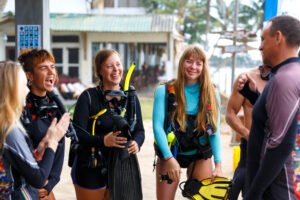
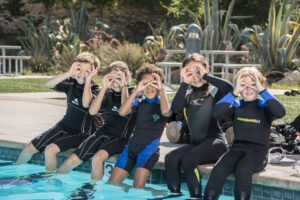
Let’s start with what matters. Diving is fun — that’s why we all come to it. But that fun has a flip side: safety. We’re operating in an environment that isn’t natural for us, and it carries real risks.
We normally learn to manage those risks on our first two courses — Open Water and Advanced Open Water. But sometimes, despite all that training, things go wrong. A chain of small events leads to an emergency. These situations are well documented — the statistics, the causes, the patterns are all known.
Emergencies can be prevented. And if one is already unfolding, you can take control. That’s exactly what we learn on the PADI Rescue Diver course.
I’ve been teaching this course in Eilat for years. Every time I see the same transformation: someone comes in as “a person who can dive” and leaves as “a diver who can handle a situation.” No wonder Rescue graduates often say the same thing — “Now I finally feel like a real diver.”
What the course actually is
PADI Rescue Diver is a rescue course — but not in the sense of dragging people out of the water. It’s about learning to notice when something is going wrong, and knowing what to do about it.
Before Rescue, you were taught to look after yourself. On Rescue, you look after yourself, your buddy, and the group.
What we actually work on:
- Managing your own stress underwater
- Helping a tired diver at the surface
- Approaching a panicked diver (so they don’t take you down)
- What to do when a diver goes missing
- Bringing an unconscious diver to the surface
- Rescue on shore or from a boat
Plus EFR — Emergency First Response. If you don’t have it, we do it in the package.
Why it’s the most useful course you’ll take
I’ll say it plainly: most diving problems happen at the surface. Not at depth, not with equipment. At the surface, before or after the dive.
Cramps. Getting tired. Panic. Broken mask. Running out of energy against a current. That’s what actually happens.
Rescue prepares you for exactly this. You learn to spot problems five minutes before they become problems. This changes your head forever.
Even if you never actually rescue anyone — you’ll simply become a more confident and attentive diver for life. That alone is worth the course.
Who needs it
By PADI standards: you need Advanced Open Water, EFR (or equivalent first aid), and logged dives.
But honestly — three types of people need this course:
1. Those who dive with family or friends. You’re responsible for more than just yourself. It helps to know what to do if your dad or your friend runs into a problem.
2. Those planning to go pro. Rescue is a mandatory step before Divemaster. No way around it.
3. Those who’ve been diving a long time. After a hundred dives, a false sense of “I know everything” creeps in. Rescue recalibrates it nicely.
How it looks in Eilat
Usually 2–3 days. Schedule looks like this:
Day 1. Theory (can be done in advance online through PADI eLearning). Dry drills on the beach, work with the manikin. Into the water — first skills: surface rescue, towing, gear removal in water.
Day 2. The remaining skills, now underwater. Bringing an unconscious diver up. Resuscitation on shore.
Day 3. Scenarios. This is the most interesting day. You come out for what looks like a normal dive. I don’t tell you what’s going to happen. At some point I “go down” — start choking, lose consciousness, panic. Your job is to recognise it and handle it. It’s stressful, it’s real practice. That’s how you find out how you’ll actually respond in a real situation.
If you’re in good shape and did the theory in advance online — we often wrap up in 2 days.
Eilat is perfect for this. Warm water, 15–25 metre visibility, shore entry. We drill on real dive sites — Abraham, North Beach, sometimes at the Pyramid. Not in a pool.
What to bring
Full equipment set is included — BCD, regulator, tanks, weights, computer (if you don’t have your own), training materials, pocket mask for CPR. Nothing extra to bring.
What you can bring your own, if you want:
- Mask, fins, snorkel — ones you’re used to
- Your own dive computer, if you have one
- Wetsuit for the season. Winter — 5 mm minimum. Summer — 3 mm or shorty
Price and time
Full pricing is in our 2026 rates post. Rescue and EFR usually go as a package — cheaper that way.
Time — 2–3 days if you’re in shape. If we add EFR and need to refresh your basics, we fit into the same window — just denser days.
I work one-on-one or with a mini-group of 2–3. No more. On Rescue, I need to see everyone.
FAQ
Do I have to be Advanced?
Yes. Advanced + EFR + 40+ logged dives are standard PADI prerequisites. If you don’t have Advanced, we do it first.
I only dive once a year on holiday — do I really need this?
Especially you. People who dive rarely lose skills faster. And knowing how to handle stress on your own is more important, not less.
I’ve got SSI Rescue but want PADI Divemaster. How does that work?
Cross-over works. PADI recognises SSI Rescue. Just bring your card.
Physically demanding?
Moderately. Towing a person 100 metres is a real test. You’ll swim 400 m non-stop and tread water for 15 minutes. Get some pool time before you come.
Can I bring a camera?
No. On Rescue your hands need to be free. And so does your head — focused on your partner, not on the shot.
Ready?
Rescue is the moment where you either decide to go pro, or you simply become a grown-up diver for the rest of your life. Both are good outcomes.
Message WhatsApp or call: 053-431-3418. We’ll talk through your background, put a schedule together, and get it done.